How to Calculate Voltage Drop and Evaluate Cable Size
Learn what causes voltage drop, how current, cable length and conductor size affect it, and why voltage drop is only one part of proper cable sizing.
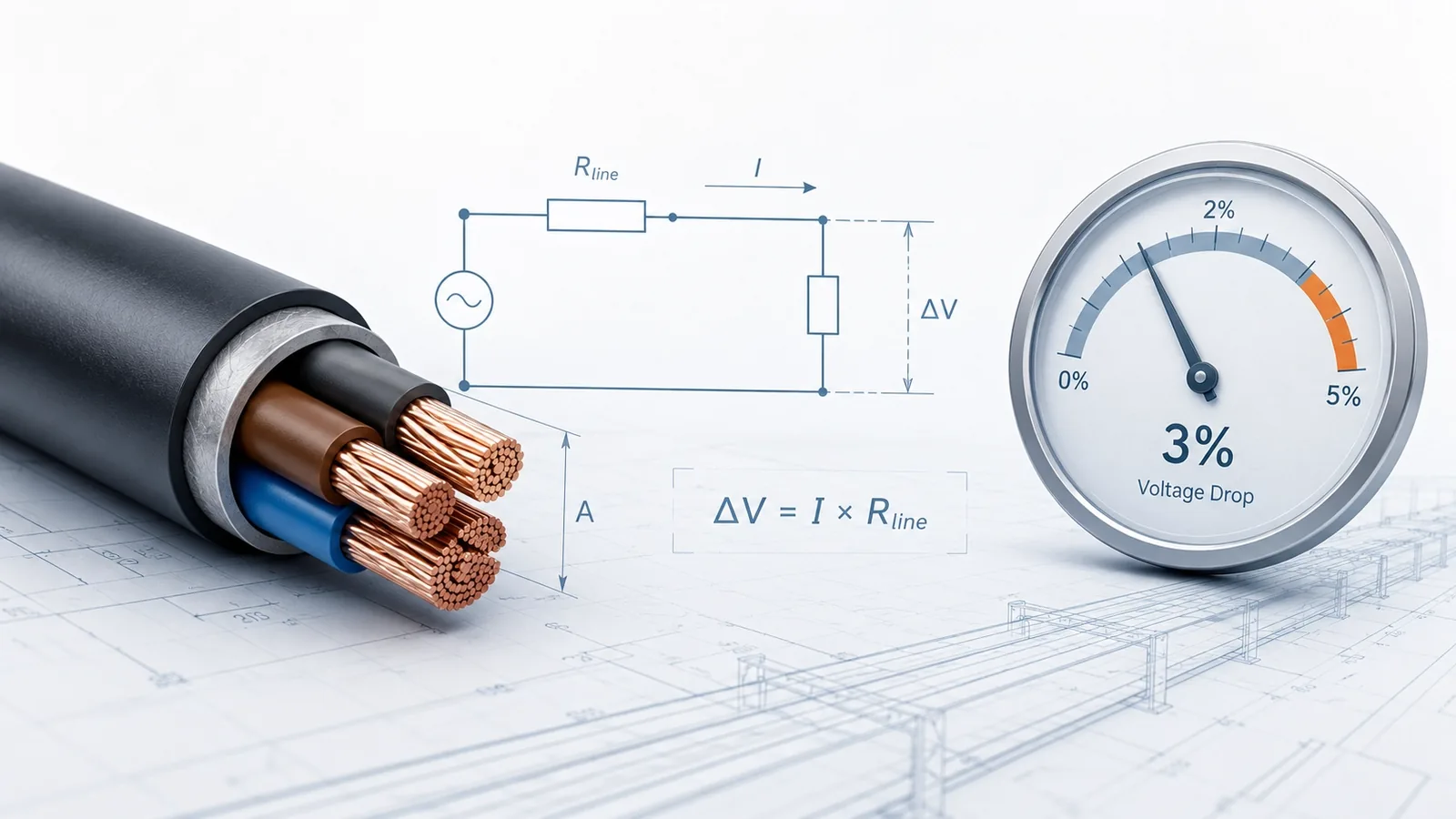
Voltage drop is the difference between the voltage available at the source of a circuit and the voltage that actually reaches the load. It exists because every real conductor has electrical resistance and, in AC circuits, reactance and power factor can also affect the result.
In practical terms, equipment connected through a long cable may receive less voltage than expected. Higher current, longer runs, and smaller conductor cross-sections generally increase the drop.
There is one crucial distinction: calculating voltage drop is not the same as fully sizing a cable. A conductor must also satisfy ampacity, temperature, installation method, grouping, overcurrent protection, short-circuit conditions, and the electrical rules that apply to the installation.
This guide explains the variables behind voltage drop, the formulas used for common circuit types, and how to use the result to evaluate whether a cable size is reasonable.
What is voltage drop?
Imagine a 230 V source feeding a load through a long cable. If the conductor causes a 6 V drop, the load receives approximately:
230 V - 6 V = 224 VThe absolute voltage drop is 6 V.
As a percentage:
drop (%) = voltage drop / source voltage × 100In this example:
6 / 230 × 100 ≈ 2.61%The percentage is useful because it lets you compare circuits with different source voltages.
A 6 V drop is about 2.6% on a 230 V circuit, but it would be a much larger percentage on a low-voltage system.
Why does voltage fall along a cable?
A real conductor resists current flow.
In a simplified resistive model, conductor resistance depends mainly on:
- conductor material;
- length;
- cross-sectional area;
- temperature.
A longer cable has more resistance. A larger cross-section has less resistance. Copper and aluminum also have different resistivities.
Temperature matters because the electrical resistance of metals increases as they get hotter. A calculation based only on ideal 20 °C values can therefore underestimate drop in some operating conditions.
In AC circuits, especially when power factor is below 1, conductor reactance can also contribute.
Cable size, wire gauge, and cross-section
The language varies by country.
Some systems describe conductors using wire gauge, while metric installations commonly use conductor cross-sectional area in square millimeters:
1.5 mm²
2.5 mm²
4 mm²
6 mm²
10 mm²
16 mm²
For the same material and length, a larger cross-section generally means lower resistance and lower voltage drop.
That is why increasing conductor size is one way to reduce drop.
But the first size that meets a voltage-drop target is not automatically the correct conductor for the whole installation.
What information do you need?
A useful calculation must reflect the actual circuit.
Circuit type
The calculation changes between:
- direct current;
- single-phase AC;
- balanced three-phase AC.
For single-phase and DC circuits, the current path normally includes the outgoing and return conductors.
For balanced three-phase circuits, the conventional voltage-drop expression uses the √3 factor instead of simply doubling the distance.
Current
Voltage drop rises with current.
A cable that performs well at 5 A can show a much larger drop at 20 A.
If you know load power rather than current, current can be estimated from voltage and, for AC loads, power factor and efficiency.
Length
Always check what the length field means.
Many calculators ask for one-way length. You enter the physical distance from source to load, and the formula accounts for the return path where required.
If you enter round-trip distance into a calculator that already doubles the length, the result will be roughly twice what it should be.
Conductor material
Copper and aluminum do not have the same resistivity.
For the same cross-section and length, their resistance is different.
Cross-sectional area
This is often the variable you are evaluating.
Larger conductor areas reduce resistance and therefore tend to reduce voltage drop.
Temperature
Temperature changes conductor resistance.
A more realistic estimate corrects resistivity for the assumed conductor temperature instead of treating it as constant.
Basic voltage-drop formulas
For direct current, a simplified expression is:
ΔV = 2 × I × L × ρ(T) / Swhere:
ΔV= voltage drop;I= current;L= one-way length;ρ(T)= resistivity corrected for temperature;S= conductor cross-section.
For single-phase AC including resistance and reactance:
ΔV = 2 × I × L × (R × cosφ + X × sinφ)For balanced three-phase AC:
ΔV = √3 × I × L × (R × cosφ + X × sinφ)Not every small installation needs detailed reactance modeling, but the formulas show why current, distance, material, and conductor size have such a strong effect.
Practical example: what changes when cable size increases?
Consider a hypothetical circuit:
- 230 V;
- single-phase;
- copper;
- 20 A;
- 40 m one-way length.
Suppose an initial cable size produces a voltage drop near 4%.
If you increase the cross-sectional area while leaving everything else unchanged, resistance falls. As a result:
- voltage drop in volts falls;
- voltage at the load rises;
- percentage drop falls.
This is the logic behind comparing cable sizes.
A voltage drop calculator can help you hold current, length, material, and voltage constant while changing only conductor size. The useful lesson is not simply which size “passes,” but how strongly the result responds to each change.
That comparison builds better intuition than looking at a single isolated number.
How to evaluate cable size using voltage drop
A practical method is to choose a project limit and compare standard conductor sizes.
Suppose 3% is being used only as the design target in this example, not as a universal code requirement.
A comparison could look like:
2.5 mm² → 4.4%
4 mm²   → 2.8%
6 mm²   → 1.9%
By the voltage-drop criterion alone, 4 mm² would be the first size in the list below 3%.
But the design is not finished.
You still need to verify that 4 mm²:
- carries the required current under real installation conditions;
- coordinates with the protective device;
- complies with applicable rules;
- withstands fault conditions;
- accounts for ambient temperature and grouping;
- is suitable for the cable type and installation method.
The accurate statement is:
“first standard size that meets the voltage-drop target”
not:
“fully sized cable.”
Copper versus aluminum
Aluminum has higher electrical resistance than copper for the same cross-sectional area.
So with current, length, and temperature held constant, aluminum will generally need a larger cross-section to achieve a similar voltage drop.
That does not mean material selection should be made using voltage drop alone.
Other considerations include:
- compatible terminals;
- connection practices;
- thermal behavior;
- weight;
- cost;
- installation method;
- local electrical requirements.
Voltage drop is one part of a broader engineering decision.
Do power factor and reactance matter?
For a nearly resistive load, power factor is close to 1 and the reactive contribution may be small.
Motors and other inductive loads can operate at lower power factors.
When reactance is relevant, the term:
R × cosφ + X × sinφaffects the calculated drop.
This becomes more important in longer circuits, larger installations, or designs where a purely resistive approximation is not accurate enough.
For a simple household estimate, assumptions may be simplified. What matters is knowing which assumptions the calculation is using.
What does “voltage at the load” mean?
In addition to percentage drop, it helps to look at the estimated voltage arriving at the equipment.
If the source is:
230 Vand calculated drop is:
8 Vthe estimated load voltage is:
222 VThat number often makes the result easier to understand.
From the equipment's perspective, the important quantity is the voltage available at its terminals while operating.
Common voltage-drop calculation mistakes
Entering round-trip length twice
If the calculator asks for one-way length and already includes the return path, manually doubling the distance overestimates the drop.
Using a current lower than the real load
Voltage drop depends directly on current. Underestimating current gives an overly optimistic result.
Using the wrong source voltage
The same drop in volts represents a different percentage depending on circuit voltage.
Treating 3% as a universal law
Design criteria and electrical rules differ by country, circuit, and application. A configurable limit is a project parameter, not a universal truth.
Sizing the cable only by voltage drop
This is the most important mistake.
A conductor can have an excellent voltage-drop result and still be unsuitable because of ampacity, temperature, protection, or installation conditions.
When can a larger conductor be worthwhile?
Even when the current size meets the chosen limit, a larger cross-section can reduce losses and increase voltage margin.
That may be useful for:
- long cable runs;
- high-current loads;
- motors;
- photovoltaic systems;
- sensitive equipment;
- circuits likely to expand later.
But oversizing without a reason increases cost, weight, space requirements, and sometimes terminal size.
The goal is not to choose the largest conductor possible. It is to choose one that works within the complete design.
A checklist before accepting a cable size
Before deciding that a conductor is suitable, check:
- circuit type;
- source voltage;
- actual current or current estimated from load power;
- one-way length;
- conductor material;
- cross-sectional area;
- assumed conductor temperature;
- power factor when relevant;
- voltage drop in volts;
- percentage voltage drop;
- estimated voltage at the load;
- conductor ampacity;
- installation method and grouping;
- overcurrent protection;
- short-circuit requirements;
- applicable local standards.
Voltage drop is one line in that checklist, although it becomes especially important on long runs.
Frequently asked questions
Does a thicker cable always reduce voltage drop?
With the other conditions unchanged, a larger cross-sectional area reduces resistance and generally reduces voltage drop.
Can I choose wire size from voltage drop alone?
No. Voltage drop is one criterion. Complete cable sizing also considers ampacity, protection, temperature, installation method, and applicable electrical rules.
Should length be one way or round trip?
It depends on the formula or calculator. Many single-phase and DC tools ask for one-way length and account for the return path internally.
Does conductor temperature really matter?
Yes. Copper and aluminum resistance increases with temperature, which raises voltage drop compared with a lower-temperature calculation.
Why does three-phase use √3?
In a balanced three-phase system, the relationship between line voltages and currents leads to the √3 factor in the conventional voltage-drop expression.
The most useful result is understanding what drives the drop
The real value of a voltage-drop calculation is not the final percentage by itself.
Keep all inputs fixed and change only conductor size. Then restore it and double the cable length. Try the same experiment with current.
A clear pattern emerges:
- more current increases drop;
- more length increases drop;
- more conductor area reduces drop;
- higher material resistance increases drop;
- higher conductor temperature tends to increase resistance.
Once those relationships make sense, the calculator stops being a black box and becomes an analysis tool.
That understanding is what makes cable-size evaluation more reliable: not searching for one magic number, but knowing why a certain size meets the voltage-drop target and which checks still remain before the circuit can be considered properly designed.