Ethanol vs. Gasoline: How to Know Which Fuel Is Cheaper
Learn how to compare ethanol or E85 with gasoline using pump prices, real fuel economy, and cost per mile instead of relying only on the 70% rule.
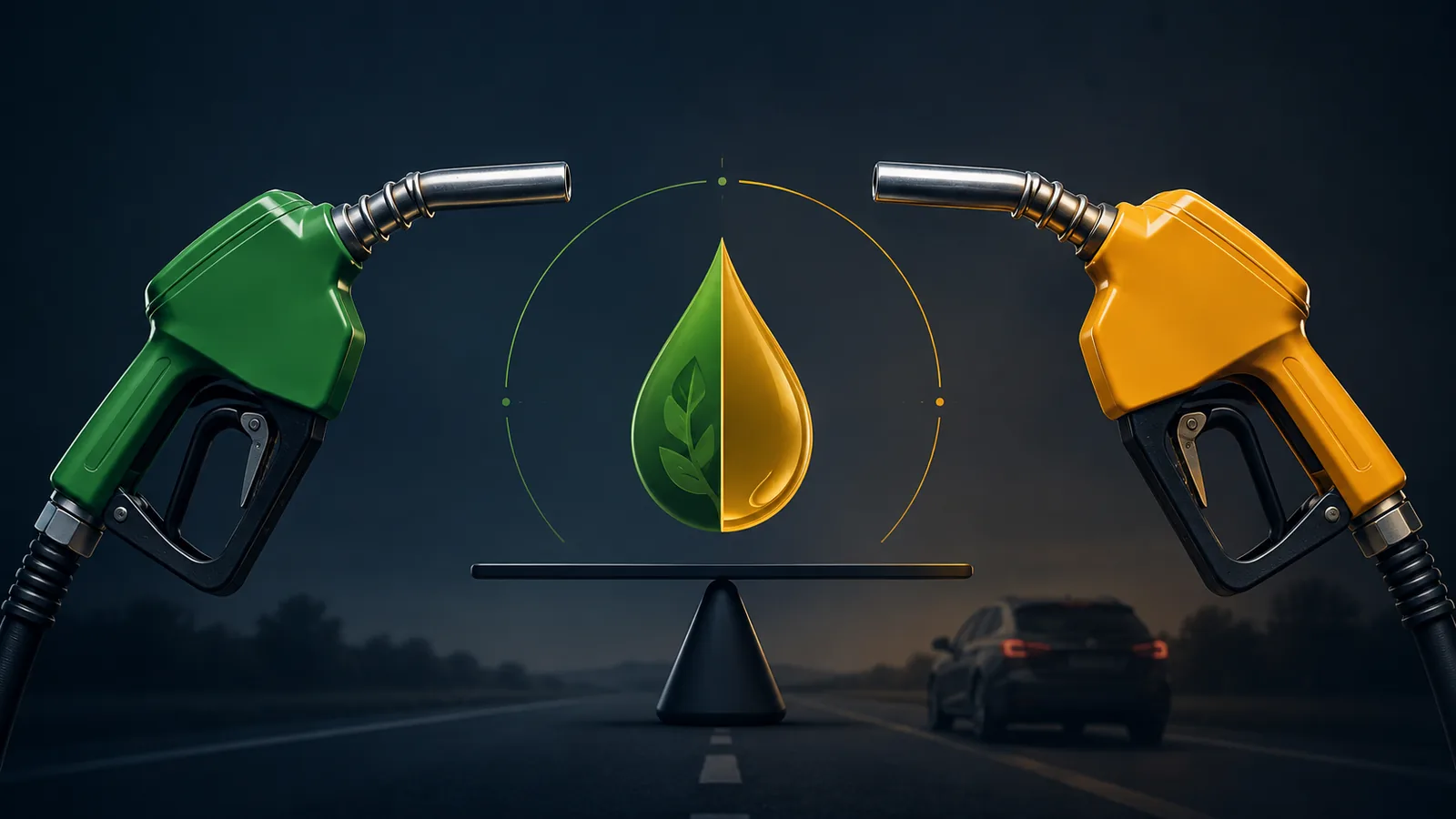
- The familiar “70% rule” is only a shortcut: divide the price of the high-ethanol fuel by the price of gasoline and compare the result with 70%.
- The real break-even point depends on how far your own flex-fuel vehicle travels on each fuel.
- A better comparison uses cost per mile or kilometer, not pump price alone.
- Fuel names and ethanol blends differ by country, so first make sure the fuel you are comparing is approved for your vehicle.
“Ethanol or gasoline?” is not the same question in every country.
In Brazil, flex-fuel drivers commonly choose between gasoline and hydrous ethanol sold as separate pump fuels. In the United States and some other markets, the closer comparison may be E85 versus regular gasoline, and availability can be regional. Elsewhere, motorists may only see lower ethanol blends already mixed into gasoline.
So before doing any math, there is one non-negotiable rule:
only compare fuels that your vehicle is designed to use.
Once that is clear, the economics are straightforward. The cheaper fuel at the pump is not automatically the cheaper fuel to drive on. What matters is how much it costs to cover the same distance.
This guide explains the 70% shortcut, shows why it can fail, and gives you a more reliable method based on actual fuel economy.
Why people use the 70% rule
High-ethanol fuel generally contains less energy per unit of volume than gasoline, so a flex-fuel vehicle often travels fewer miles or kilometers on the same volume.
That means ethanol needs to be sufficiently cheaper at the pump to offset the lower fuel economy.
The traditional shortcut is:
ethanol price ÷ gasoline price × 100
If ethanol is below roughly 70% of gasoline's price, the shortcut favors ethanol. If it is above that mark, it favors gasoline.
For example:
- high-ethanol fuel: $3.10 per gallon;
- gasoline: $4.50 per gallon.
3.10 ÷ 4.50 × 100 ≈ 68.9%
The quick rule says ethanol has the price advantage.
A fuel comparison can calculate that ratio and show the approximate break-even price without requiring a spreadsheet.
The 70% figure is not a physical law. It represents an assumed relationship between fuel economy on ethanol and gasoline. Your vehicle's real break-even point can be higher or lower.
Why 70% is not universal
Suppose one flex-fuel vehicle gets:
- 22 mpg on E85;
- 30 mpg on gasoline.
Its relative fuel economy is:
22 ÷ 30 × 100 ≈ 73.3%
For that vehicle, ethanol could cost as much as about 73% of the gasoline price and still be competitive on cost per mile.
Another vehicle might get:
- 18 mpg on high-ethanol fuel;
- 30 mpg on gasoline.
18 ÷ 30 × 100 = 60%
That vehicle would need a much larger pump-price discount before ethanol becomes cheaper per mile.
This is why “E85 is under 70%, so it must be cheaper” can be wrong for a specific car.
The better method: cost per distance
The most useful formula is:
cost per distance = fuel price ÷ fuel economy
If your prices are per gallon and economy is in miles per gallon, the result is cost per mile.
If prices are per liter and consumption is in km/L, the result is cost per kilometer.
The principle is identical as long as the units are consistent.
Example:
- E85: $3.10/gal;
- gasoline: $4.50/gal;
- E85 economy: 21 mpg;
- gasoline economy: 29 mpg.
E85:
3.10 ÷ 21 ≈ $0.148 per mile
Gasoline:
4.50 ÷ 29 ≈ $0.155 per mile
In this example, the high-ethanol fuel is cheaper to drive on even though it delivers lower fuel economy.
If you need to move between gallons, liters, miles, and kilometers, a unit converter can keep the inputs consistent before you compare them.
Your personal break-even percentage
You can calculate a vehicle-specific threshold with:
ethanol fuel economy ÷ gasoline fuel economy × 100
Using the previous example:
21 ÷ 29 × 100 ≈ 72.4%
That means the high-ethanol fuel is economically competitive while its pump price remains below roughly 72.4% of the gasoline price, assuming those fuel-economy averages remain representative.
A break-even percentage is an estimate, not a guarantee. Fuel economy changes with temperature, traffic, speed, tire pressure, trip length, load, driving style, and seasonal fuel formulations.
A note about units in the calculator
The underlying comparison is based on ratios, so the quick price test works as long as both fuel prices use the same unit.
However, detailed trip, tank, and cost-per-distance estimates require consistent distance and volume units.
The detailed calculator mode is designed around liters, kilometers, and km/L. If your local pump uses gallons and your dashboard uses mpg, convert your measurements first if you want the detailed outputs to represent the correct distances and tank ranges.
How to measure real fuel economy
EPA or manufacturer estimates are useful starting points, but your own driving pattern may differ.
For a practical comparison, measure both fuels under similar conditions.
- Fill the tank consistently and reset the trip odometer.
- Drive a representative amount on one approved fuel.
- At the next fill-up, record the distance traveled and the amount of fuel added.
- Calculate distance divided by volume to get your average fuel economy.
- Repeat over more than one tank to reduce the impact of a single unusual trip.
- Measure the other fuel under similar weather, route, traffic, and driving conditions.
- Use the two averages to calculate your personal break-even ratio.
If you compare an E85 tank used entirely in stop-and-go winter driving with a gasoline tank used on a warm highway trip, the result says as much about the trips as it does about the fuels.
Example: ethanol wins despite lower mileage
Assume:
- high-ethanol fuel: $2.85/gal;
- gasoline: $4.20/gal;
- high-ethanol economy: 20 mpg;
- gasoline economy: 28 mpg.
Price ratio:
2.85 ÷ 4.20 × 100 ≈ 67.9%
Fuel-economy ratio:
20 ÷ 28 × 100 ≈ 71.4%
Because the fuel's price ratio is below the vehicle's 71.4% break-even point, it has the lower cost per mile.
Cost per 100 miles:
High-ethanol fuel:
100 ÷ 20 × 2.85 = $14.25
Gasoline:
100 ÷ 28 × 4.20 = $15.00
The difference is $0.75 per 100 miles.
That is not dramatic on one short trip, but it becomes more meaningful for a driver covering many miles each month.
Example: the 70% shortcut gives the wrong answer
Now assume:
- high-ethanol fuel: $3.00/gal;
- gasoline: $4.40/gal;
- ethanol economy: 18 mpg;
- gasoline economy: 30 mpg.
Price ratio:
3.00 ÷ 4.40 × 100 ≈ 68.2%
The quick rule would lean toward ethanol.
But the vehicle's fuel-economy ratio is:
18 ÷ 30 × 100 = 60%
Cost per 100 miles:
High-ethanol fuel:
100 ÷ 18 × 3.00 ≈ $16.67
Gasoline:
100 ÷ 30 × 4.40 ≈ $14.67
Gasoline is clearly cheaper per mile.
Quick price rule
Uses only the two pump prices.
Useful when you need an immediate estimate.
The traditional reference is about 70%.
Actual fuel economy
Uses price plus your vehicle's measured efficiency on each fuel.
Produces a vehicle-specific break-even point.
Better for cost per distance, monthly spending, and range decisions.
The cheapest fill-up is not always the cheapest driving
A tank of E85 or ethanol can cost noticeably less to fill because the pump price is lower.
But if the vehicle consumes more volume over the same trip, the lower receipt at the pump does not automatically mean lower operating cost.
Always connect two numbers:
money spent + distance traveled
That same principle applies to road trips. If you want to estimate total fuel spending for a planned drive, a fuel cost calculator can combine trip distance, efficiency, and price.
Range can matter even when cost is tied
High-ethanol fuel often produces shorter range per tank in a flex-fuel vehicle.
If the cost per mile is nearly identical, gasoline may be more convenient for a long highway trip because it can reduce fuel stops.
For another driver, the lower pump price or local availability of ethanol may matter more.
When the financial difference is small, consider:
- range per tank;
- number of fuel stops;
- local availability;
- route and driving conditions;
- expected mileage before the next fill-up.
Do not pretend a fraction of a cent per mile is a decisive advantage if normal fuel-economy variation can erase it.
Monthly savings: where small differences become visible
Suppose:
- ethanol option: $0.145 per mile;
- gasoline: $0.158 per mile;
- monthly driving: 1,200 miles.
Ethanol:
0.145 × 1,200 = $174
Gasoline:
0.158 × 1,200 = $189.60
Estimated difference:
$15.60 per month
The number is only as good as the fuel-economy and price inputs, so recalculate when prices change substantially.
If you want to express a pump-price change or savings rate as a percentage, a percentage calculator can make that part easier.
E85, “ethanol,” and gasoline are not identical labels worldwide
The word ethanol can refer to different fuel products depending on the country.
A few practical distinctions matter:
- some markets sell high-ethanol blends such as E85 for flex-fuel vehicles;
- Brazil widely uses a separate hydrous ethanol fuel for flex cars;
- standard gasoline itself often contains some ethanol;
- actual ethanol content can vary by product, season, and jurisdiction.
This is one reason a break-even figure copied from another country or another blend may not match your car.
Use the actual fuel sold at your pump and the actual mileage you observe with it.
Vehicle compatibility comes before savings
A gasoline-only vehicle should not be treated as a flex-fuel vehicle simply because ethanol is cheaper.
Use only fuels approved by the vehicle manufacturer. A price comparison does not determine mechanical compatibility. Check the owner's manual, fuel-door label, or manufacturer guidance before using a high-ethanol blend.
Why your measured MPG changes
Fuel economy is not a fixed property of the fuel alone.
It also changes with:
- ambient temperature;
- short trips and cold starts;
- highway speed;
- stop-and-go traffic;
- tire pressure;
- vehicle load;
- terrain;
- air conditioning or heating use;
- driving style;
- maintenance condition.
For a useful comparison, work with averages rather than a single trip.
What if the result is almost a tie?
Suppose your calculated costs are:
- ethanol: $0.151/mile;
- gasoline: $0.152/mile.
That difference is too small to treat as a confident prediction.
A slight change in traffic or fuel economy could reverse it.
Near the break-even point, range and convenience are often more important than the theoretical winner.
Common mistakes
- Treating 70% as a universal rule for every vehicle and every ethanol blend.
- Comparing pump price without comparing fuel economy.
- Using MPG from a highway trip for one fuel and city driving for the other.
- Comparing fuels that the vehicle is not approved to use.
- Mixing price-per-gallon with consumption measured in km/L without conversion.
- Using one unusually good or bad tank as the long-term average.
- Ignoring range when the cost-per-mile difference is tiny.
- Assuming a fuel sold as “ethanol” has the same composition in every country.
A simple decision process at the pump
If your vehicle is approved for both fuels, keep two realistic fuel-economy averages.
Then:
- calculate the ethanol-to-gasoline price ratio;
- calculate your vehicle's ethanol-to-gasoline efficiency ratio;
- compare those percentages;
- if the price ratio is clearly lower, ethanol is cheaper per distance;
- if it is clearly higher, gasoline is cheaper;
- if they are very close, treat the result as a practical tie.
That turns a generic internet rule into a decision based on your own vehicle.
Frequently asked questions
Is ethanol always worth it below 70% of gasoline?
No. That is a useful shortcut, but your vehicle's actual fuel-economy penalty determines the real break-even point.
Is E85 the same as pure ethanol?
No. E85 is a high-ethanol blend, and its exact composition can vary. Fuel names and blends differ by market.
Can I use the price ratio with dollars per gallon?
Yes. The ratio works with any currency and volume unit as long as both fuel prices use the same unit.
Is cost per gallon or cost per mile more important?
Cost per mile is the better measure if your goal is to minimize driving cost because it incorporates fuel economy.
Why is range lower on high-ethanol fuel?
A flex-fuel vehicle generally needs more volume of high-ethanol fuel to travel the same distance, so a fixed-size tank often provides fewer miles.
Should I switch fuels every time prices move?
Not necessarily. Recalculate when the price relationship changes enough to matter. Near break-even, convenience and range may outweigh a very small theoretical saving.
Bottom line
The 70% rule is a useful shortcut, but the better question is:
What does each fuel cost me per mile or kilometer in my vehicle?
Start with the pump-price ratio. Improve it with your real fuel economy. Then translate the difference into cost per distance and monthly spending.
The most economical choice can change as prices, seasons, routes, and driving patterns change. A good comparison is therefore not a one-time verdict—it is a simple calculation you can revisit whenever the numbers move.