How Much Paint Do I Need? Calculate Walls, Rooms, and Ceilings
Learn how to estimate paint for walls, rooms, and ceilings using surface area, number of coats, product coverage, doors and windows, and a practical allowance for waste.
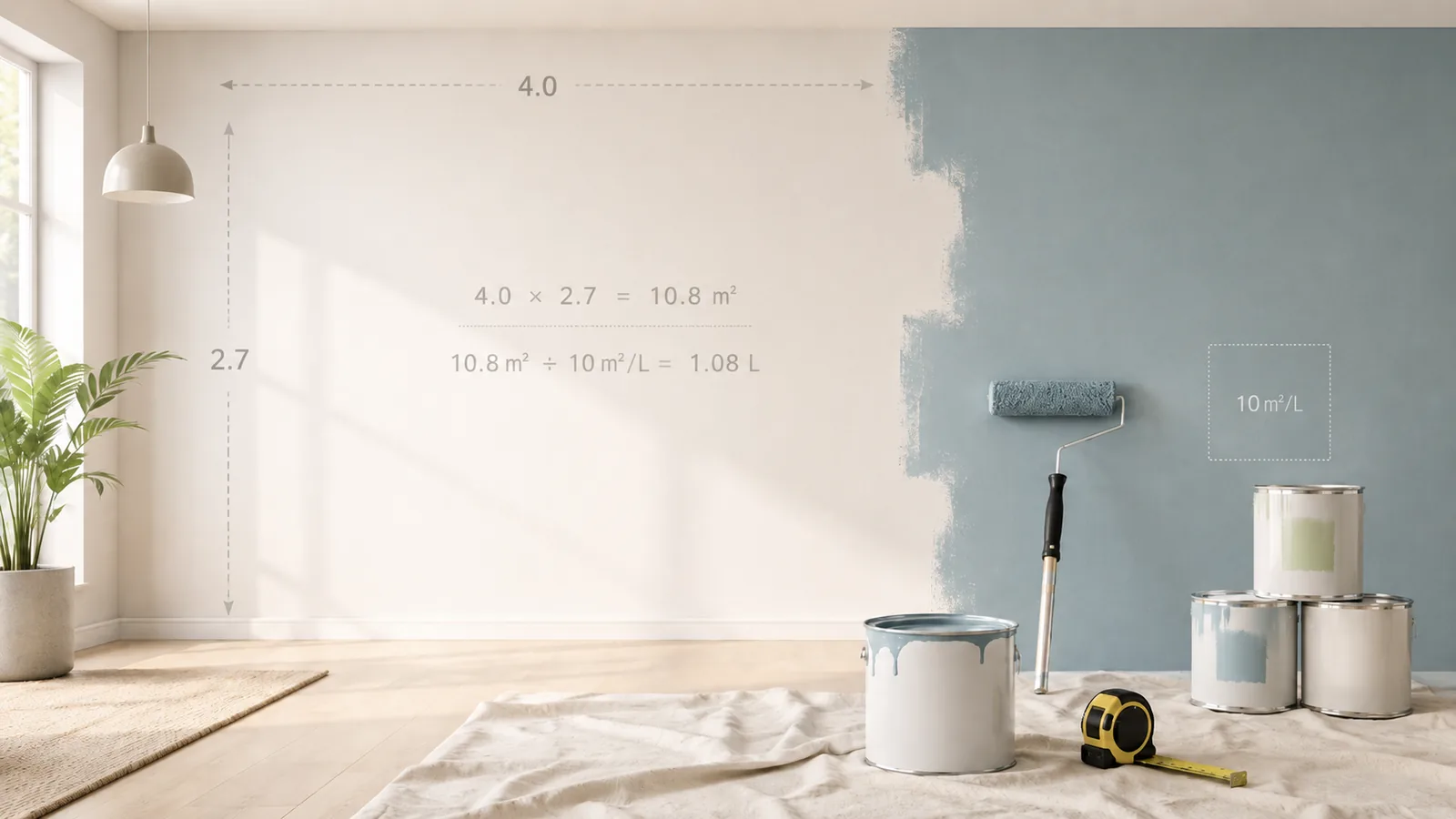
- To estimate paint, calculate the surface area you will actually paint, multiply by the number of coats, then divide by the coverage rate printed on the paint label.
- Subtract large doors and windows when they materially reduce the area, and add a small allowance for waste and touch-ups.
- In the U.S., paint coverage is often shown in square feet per gallon; elsewhere, square meters per liter are common. Keep all units consistent.
- Your final purchase must be rounded to available can sizes, so the theoretical volume and the amount you buy will rarely match exactly.
Buying paint is one of those projects where “close enough” can be expensive. Too little paint means another trip to the store and a risk of color variation between batches. Too much means paying for material that may sit unused in a garage or closet.
The reliable approach is to calculate surface area, coats, coverage, and a reasonable allowance before choosing container sizes.
This guide works whether you are painting one accent wall, an entire bedroom, a ceiling, or several rooms. It also explains how to handle the unit difference between paint sold in gallons and coverage calculators built around liters and square meters.
The basic paint formula
The core equation is:
paint volume = surface area × number of coats ÷ coverage rate
In metric units, if you have:
- 30 m² of wall;
- 2 coats;
- coverage of 10 m²/L;
then:
30 × 2 ÷ 10 = 6 L
In U.S. customary units, the same idea is:
square feet × coats ÷ square feet per gallon = gallons required
A paint coverage calculation can combine area, coats, coverage, waste allowance, container size, and price into one estimate.
“Coverage” is the area a specified amount of paint is expected to cover under the manufacturer's stated conditions. Use the coverage rate for the exact product you plan to buy rather than a generic number from the internet.
Step 1: measure one wall correctly
For a rectangular wall:
area = width × height
A wall that is 12 ft wide and 8 ft high is:
12 × 8 = 96 sq ft
A metric wall measuring 4 m × 2.7 m is:
4 × 2.7 = 10.8 m²
For irregular walls, split the surface into rectangles and triangles, calculate each section, then add the results.
- Measure the width of every wall that will be painted.
- Measure the height from floor to the upper paint line.
- Multiply width by height for each rectangular section.
- Add all wall areas together.
- Subtract large doors, windows, tile, cabinets, or other surfaces that will not be painted.
- Multiply the net area by the number of coats.
- Divide by the paint's stated coverage rate, then add your chosen allowance for waste and touch-ups.
How to calculate all four walls of a room
You can measure each wall separately or use the room perimeter.
For a 12 ft × 10 ft room with 8 ft ceilings:
Perimeter:
12 + 12 + 10 + 10 = 44 ft
Gross wall area:
44 × 8 = 352 sq ft
Suppose the room has:
- one 3 ft × 7 ft door = 21 sq ft;
- one 4 ft × 4 ft window = 16 sq ft.
Net area:
352 - 21 - 16 = 315 sq ft
For two coats:
315 × 2 = 630 sq ft of coverage
If the selected paint says 350 sq ft per gallon:
630 ÷ 350 = 1.8 gallons
You would then choose among the container sizes sold by that manufacturer.
Square feet and gallons versus square meters and liters
English-language paint labels vary by country.
In the United States, you will commonly see:
- square feet;
- gallons;
- quarts;
- square feet per gallon.
In the U.K., Australia, and many other markets, liters and square meters are more common.
The ProntoUso paint calculator uses m², liters, and m² per liter. If your label is in U.S. units, convert before entering detailed values.
Useful references:
- 1 m² ≈ 10.764 sq ft;
- 1 U.S. gallon ≈ 3.785 L.
A unit converter is useful when the room measurements and paint label are not in the same system.
Do not mix square feet with m²/L or square meters with sq ft/gal in the same equation. The formula is simple only when the units match.
Should you subtract doors and windows?
For a precise estimate, yes—especially when openings are large.
But you do not need to obsess over every small outlet cover or narrow trim strip.
There are two sensible approaches:
Fast estimate
Keep small openings in the total wall area.
Their area effectively becomes part of your allowance for touch-ups and minor losses.
Detailed estimate
Subtract doors, windows, built-ins, tile, and other large unpainted areas.
Then add a separate, intentional waste allowance afterward.
Avoid subtracting the same area twice. If you already reduced the wall area for a large window, do not also increase your “waste” percentage because of that same window.
Do not forget the ceiling
Ceiling area is usually:
length × width
A 12 ft × 10 ft room has:
12 × 10 = 120 sq ft
If the ceiling gets two coats, coverage required is:
120 × 2 = 240 sq ft
Calculate ceiling paint separately when the product, color, sheen, or coverage differs from the walls.
How many coats should you plan for?
The number of coats has a direct effect on quantity.
Two coats roughly double the area the paint must cover compared with one coat.
But the correct number depends on:
- the product instructions;
- old and new colors;
- surface condition;
- primer use;
- repairs and patches;
- paint quality;
- sheen and color intensity.
Changing from a dark color to a light one may require more work than repainting a similar color. Some vivid colors also need additional coats for uniform appearance.
Use the manufacturer's recommendation rather than automatically assuming two coats.
Why label coverage beats a rule of thumb
You may see advice such as “one gallon covers about 350–400 square feet.” That can be useful for a rough shopping list, but it should not override the actual label.
Coverage varies between:
- primers;
- flat, eggshell, satin, and other finishes;
- interior and exterior coatings;
- masonry products;
- textured surfaces;
- different product lines.
The label also tells you whether the stated coverage assumes a particular surface or application method.
Why add an allowance?
Perfect geometry does not account for real painting.
Some paint is lost or used in:
- rollers and brushes;
- trays and buckets;
- cutting in around edges;
- porous patches;
- texture;
- spills;
- later touch-ups.
The calculator separates the theoretical liters from the volume after a waste percentage is added. fileciteturn49file0L2-L2
For a straightforward interior job, people often choose a modest allowance, but there is no universal percentage. A rough wall or textured surface may need a different buffer than a smooth, sealed wall.
If you want to see exactly what a 5%, 10%, or 15% allowance adds to a quantity, a percentage calculator can make that comparison easy.
New drywall and porous surfaces
Fresh drywall, plaster, masonry, and repaired patches can absorb coatings unevenly.
Primer or sealer may be part of the recommended system, and it should usually be calculated as a separate product with its own coverage rate.
Trying to solve a preparation problem by simply buying more finish paint is not always efficient.
Follow the coating manufacturer's preparation instructions for the specific substrate.
Example: a complete bedroom estimate
Suppose a bedroom measures 4 m × 3 m with 2.6 m walls.
Perimeter:
4 + 4 + 3 + 3 = 14 m
Gross wall area:
14 × 2.6 = 36.4 m²
Subtract:
- door: 1.6 m²;
- window: 1.8 m².
Net wall area:
36.4 - 3.4 = 33.0 m²
Two coats:
33 × 2 = 66 m²
Coverage:
10 m²/L
Theoretical paint:
66 ÷ 10 = 6.6 L
Add 10% allowance:
6.6 × 1.10 = 7.26 L
If the product is sold in 3.6 L cans, the theoretical requirement sits just above two cans, so you would need to compare available sizes rather than buying a fractional container.
The tool follows this same logic: it calculates liters, applies the allowance, rounds the number of containers upward, and multiplies by the entered can price for an estimated material cost. fileciteturn49file0L2-L2
How container sizes affect the purchase
The exact mathematical volume is not the final shopping quantity.
A calculation may say you need 7.3 liters, but the store may offer:
- 1 L cans;
- 3.6 L cans;
- 18 L pails;
or, in another market:
- quarts;
- 1-gallon cans;
- 5-gallon buckets.
Compare the total cost and leftover amount. A larger container can sometimes be cheaper per unit even if it leaves more paint.
Keeping a small amount for future touch-ups can also be useful, especially for a custom color.
What about trim, doors, and baseboards?
Calculate them separately when they use a different paint.
Trim often uses a different sheen or product and may be measured by linear length rather than broad wall area.
For doors, calculate both faces if both will be painted. Do not automatically subtract a door from the wall and then forget that the door itself may require paint of another type.
Exterior walls need their own assumptions
The geometry is the same, but exterior surfaces can change the practical coverage because of:
- rough siding;
- stucco or masonry;
- weather exposure;
- more edges and details;
- difficult access;
- product-specific application requirements.
Use the exterior paint's stated coverage rather than reusing an interior estimate.
Common paint-calculation mistakes
- Using floor area as if it were wall area.
- Forgetting to multiply by the number of coats.
- Using a generic coverage rate instead of the selected paint's label.
- Mixing square feet and metric coverage units.
- Subtracting doors and windows twice.
- Forgetting a ceiling that is also being painted.
- Calculating finish paint and primer as if they had the same coverage.
- Buying exactly the theoretical volume with no allowance for touch-ups.
- Rounding intermediate numbers too aggressively.
- Ignoring the actual container sizes sold at the store.
A practical shopping workflow
Before you buy, collect these numbers:
- net wall area;
- ceiling area, if included;
- number of coats;
- product coverage rate;
- allowance percentage;
- container sizes;
- price per container.
The calculator in the project uses those same inputs to return painted area, liters including waste, cans needed, and estimated cost. fileciteturn50file0L2-L2
That makes the calculation useful for both quantity and budget.
Frequently asked questions
How much paint do I need for 200 square feet?
It depends on coats and coverage. With two coats, you need 400 sq ft of total coverage. At 400 sq ft per gallon, that is theoretically 1 gallon before an allowance.
Does a second coat really double the paint?
In the planning formula, it doubles the coverage requirement. Real use can vary, but estimating by coat count is safer than pretending the second coat uses no material.
Should I subtract every door and window?
Subtract large openings when accuracy matters. Small areas can often remain in the total and effectively become part of the buffer.
How much extra paint should I buy?
There is no single correct percentage. Consider surface texture, application difficulty, future touch-ups, and the available can sizes.
Can I use the same calculation for primer?
Yes, but use the primer's own coverage rate and number of coats rather than assuming it matches the finish paint.
How do I calculate a triangular wall section?
Use base × height ÷ 2, then add that area to the rectangular sections.
Bottom line
A reliable paint estimate follows this sequence:
measure the surface → subtract major unpainted areas → multiply by coats → divide by product coverage → add an allowance → round to real container sizes.
The key is not memorizing a universal “coverage per gallon” number. It is using the exact product's stated coverage and measuring the actual surfaces you intend to paint.
A few minutes of measurement before shopping can prevent both the mid-project emergency run and the expensive stack of unopened paint left afterward.